Jasper County rewards people who walk it slowly. The towns are small enough to cross on foot, the courthouse squares and old commercial blocks hold most of the history that is still readable, and the county's preserves give the rest of the story away only at the pace of a person on a trail. Guided options exist, and they are easier to arrange than most visitors expect.
Walking Tours in Rensselaer
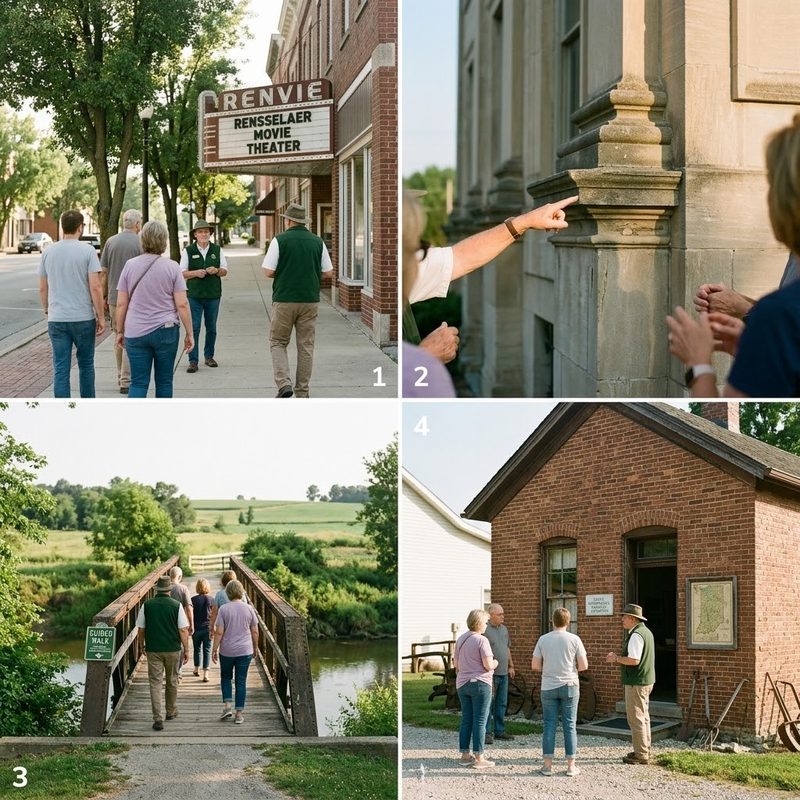
The county's organized walking tours run out of the Jasper County Welcome Center on West Washington Street, and they are built around the downtown grid rather than a museum route. Tours leave on Third Thursday evenings from May through October at six o'clock, and on Second Saturday mornings from June through October at ten, which lines up neatly with the days the downtown is already open late or busy in the morning.
Everything starts at the welcome center, and that is the practical part: someone hands you a route, points out the buildings worth stopping for, and tells you which blocks have the best murals that year. Arrive a little early. Tours go out in small groups, the streets are shared with traffic, and spring weather in Northwest Indiana does not negotiate.
The walks themselves are moderate and mostly flat, which suits almost any age, and they cover a few blocks rather than a few miles. Wear whatever you would wear to a farmers market, bring water if the day is warm, and expect to stop often. The guides are locals, and the detours they take when a door is open or a story occurs to them are usually the part people remember.
Mural Tours Across Three Towns
The public art is spread over Rensselaer, Remington and DeMotte, and it is deliberately a mix of professional work and pieces made by local amateurs. That combination is the point of the project: the walls are meant to read as a shared voice rather than a single commission. Because the route covers three downtowns, it works best as a driving day with a walk in each stop instead of one long stroll.
You can do the mural route entirely on your own, and most people do. Pick up a map at the welcome center, decide which town you want at the brightest hour of the day, and photograph what you like. New work goes up on a rolling basis, so a second visit never looks like the first one, and the older walls tend to be the ones locals will stop and explain if you ask.
The Farm Trail and Other Driving Tours
For anyone who prefers a windshield, the county's farm trail is a self-guided loop through Remington, Rensselaer, Wheatfield and DeMotte that links a wide range of locally grown and made products. Nothing about it is scheduled, which is its strength: you stop where the sign is out and the door is open, and you skip the rest. A map and flyer are available through the county, and the stops are far enough apart that the drive is part of the attraction.
The same logic applies to the murals and the shops. Build a rough order of towns, keep the mileage in mind, and leave a gap in the middle of the day for whatever you find between two planned stops. Half of a good Jasper County tour is the unlisted part, and the farm stops are where the growers will talk for as long as you keep asking questions.
If you are bringing a group, the driving tours are the ones that scale. A self-guided route needs no reservation, nobody has to keep pace with a stranger, and the loop can be cut short when a child falls asleep in the back. Print the map before you leave rather than relying on a signal that drops out between farmsteads.
Nature Walks and Birding Outings
The preserves are the other kind of tour, and they are mostly self-guided. Fisher Oak Savanna and Gish Wildlife Area sit near Rensselaer, Prairie Border and Stoutsburg Savanna are out toward Wheatfield, Thomas Ciurus is on the DeMotte side, and Jasper-Pulaski Fish and Wildlife Area spreads across more than eight thousand acres of wetland. The observation tower there draws birders from October through February, when tens of thousands of sandhill cranes use the shallow marshes on their southward migration.
These walks ask more of you than a downtown stroll. Trails are unpaved, the ground stays soft after rain, and the cranes are visible at the ends of the day rather than on demand. Bring binoculars, dress in quiet colors, and give yourself more time than the distance on the map suggests. Most people who come for an hour stay for two.
The preserve trails are self-guided, but that does not mean they are unmarked. Each one has a short loop that suits a casual walker and longer options that reach the savanna and wetland edges, and the county keeps flyers for several of them at the welcome center. Go in the morning, tell somebody which trail you chose, and watch the weather rather than the clock.
Arranging Your Own Guided Visit
If you want a guide for a group, a class or a family, the welcome center is the place to start. They keep itineraries, maps and event calendars on the counter, they know which walks are in good condition that month, and they can point you toward the organizations that run the county's festival and preservation work. Stopping in during the week is usually enough.
For anything larger, plan around the county's rhythms rather than against them: mornings for the preserves, late afternoons for the squares, and a Third Thursday if you want a crowd and a walking tour on the same evening. Keep the group small, wear shoes you have already walked in, and let the tour finish near somewhere you can sit down with food. The best-guided days here end at a table.