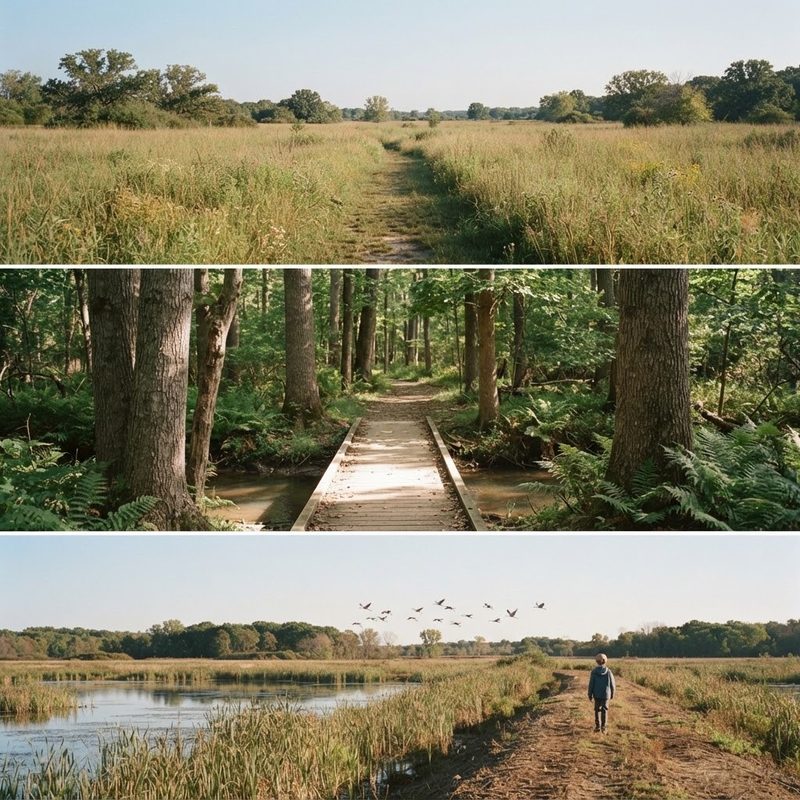
Jasper County sits on flat, open land in Northwest Indiana, and its hiking is prairie, savanna, wetland and oak opening rather than hills and switchbacks. That suits people who want a long, level walk with birdsong and a big sky more than a climb. The county's preserves are scattered between Rensselaer, Wheatfield and DeMotte, each with its own character, and most are free to enter with nothing more than a pair of decent shoes.
Start With the Map
The Take a Hike flyer available from the Jasper County Welcome Center in Rensselaer lists the county's principal natural areas, and the interactive map on the county site marks each one. Pick up the paper version before you set out: gate hours, gravel approaches and patchy cell service make a phone a poor substitute once you are out among the fields.
Build the day around two preserves rather than four. Distances between them are short, but the pleasure of a place like Prairie Border or Stoutsburg Savanna comes from slowing down enough to notice what is moving in the grass. A morning at one and an afternoon at another, with lunch in Rensselaer or DeMotte in between, is the shape of a good hiking day here.
Most of these lots are daylight-only and some roads in are gravel, so arrive with time to spare and check conditions after heavy rain. Water, insect spray in summer and a wind layer in the colder months cover almost everything the county can throw at you.
Near Wheatfield: Prairie Border and Stoutsburg
Prairie Border Nature Preserve, outside Wheatfield, is the county's signature prairie walk. Expect a mile or so of level path through grass and wildflower that reaches chest height in high summer, with insects everywhere in July and the whole field going copper and gold by early October. Spring brings the sharpest greens and the fewest people, and it is also the best month to hear the birds before the grass hides them.
Stoutsburg Savanna Nature Preserve sits in the same corner of the county and offers a shorter, quieter loop through oak savanna: open-grown trees, dappled light and a floor of leaf litter and grass. It pairs well with Prairie Border as a half-day, and it is at its best in late spring when the oaks leaf out and again in autumn when the understory turns.
Neither place is built for speed. Trails here are mowed or worn rather than graded, so after a wet stretch the ground stays soft underfoot. Go in the morning, when the dew is still on the grass, and give yourself an hour to cover what looks, on paper, like a very short walk.
Near Rensselaer: Fisher Oak and Gish
Fisher Oak Savanna Nature Preserve is the closest of the big preserves to Rensselaer, which makes it the easiest fit for an hour you did not plan to spend. The star is the oak itself: ancient, wide-crowned trees standing in open grass, the kind of savanna that once covered much of Indiana and now survives in small, protected islands like this one.
Gish Wildlife Area, also outside Rensselaer, is a gentler proposition: open ground and water that draws birds year-round and is at its most rewarding at dawn. It is a place for slow walking with binoculars rather than mileage, and it works well as an early stop before breakfast in town. Bring a scope if you own one; the sightlines are long and the birds keep their distance.
Together the two make a Rensselaer morning that costs nothing and finishes within minutes of the courthouse square. On Saturdays you can add the farmers' market from May to October, which runs on the south side of the courthouse until late morning.
The Big One: Jasper-Pulaski
The Jasper-Pulaski Fish and Wildlife Area is 8,062 acres of wetland, making it by far the largest place to walk in the county and the reason a lot of people come here at all. In fall it hosts roughly ten thousand sandhill cranes, which gather in the shallow marshes during their southward migration in one of the great wildlife spectacles in the Midwest.
An observation tower gets visitors close to the action from October through February, and the crowds of birds arrive with the cold. Dress for standing still: warm layers, dry boots, hat and gloves, plus binoculars you can work with covered hands. The cranes usually announce themselves before you see them, a rolling chorus carrying across the marsh.
Outside crane season the area still offers miles of ground for walking, hunting and fishing, with the seasons and regulations of a managed wildlife area. Check current conditions before driving out, as access and open zones change through the year.
DeMotte and the Savanna Trail
Thomas Ciurus Nature Preserve, on DeMotte's side of the county, is the best wooded walk near town: a shorter loop under trees that stays comfortable on a hot day when the prairie offers no shade at all. DeMotte's Spencer Park, Field of Dreams Park and Freedom Park add easy, mowed routes for anyone who wants a stroll with a playground at the end of it.
DeMotte is also the natural place to finish a hiking day, with the longest list of restaurants and ice cream counters in the county. A table there, a map for tomorrow and a short drive back to lodging is about as well as a day on the trails can end.
When to Go and What to Bring
May and June are the sweet spot: green prairie, active birds and enough daylight to linger. July and August are beautiful but buggy, so insect spray is not optional and long sleeves earn their keep. September and October bring migrating cranes, turning savanna and the county's clearest light, while winter strips everything back to structure and is the best season for Jasper-Pulaski.
Whatever the month, carry water, a paper map, and a layer more than you think you need. The preserves are flat, which lures people into underestimating the distance, and the wind moves across open country without anything to block it. Walk out slowly, look up often, and give the county the kind of afternoon it is built for.